Back in 1938, Harvard researchers launched what would become the longest-running study of adult life ever conducted.
The study followed hundreds of people from different backgrounds, and later their partners and children, tracking their health, work and relationships across entire lifetimes.
More than 85 years later, the Harvard Study of Adult Development reached a striking conclusion. The greatest predictor of our long-term health and happiness was not money, professional success or genetics, but the strength of our relationships.
The wider health case is supported by an analysis of 148 studies, which found that people with stronger social relationships had a 50% greater likelihood of living longer than those with weaker relationships.
Meanwhile, one study using British data found that having a close friend produced the same increase in life satisfaction as earning an additional $150,000 a year.
Yet across Britain, the conditions that allow friendship to form are weakening.
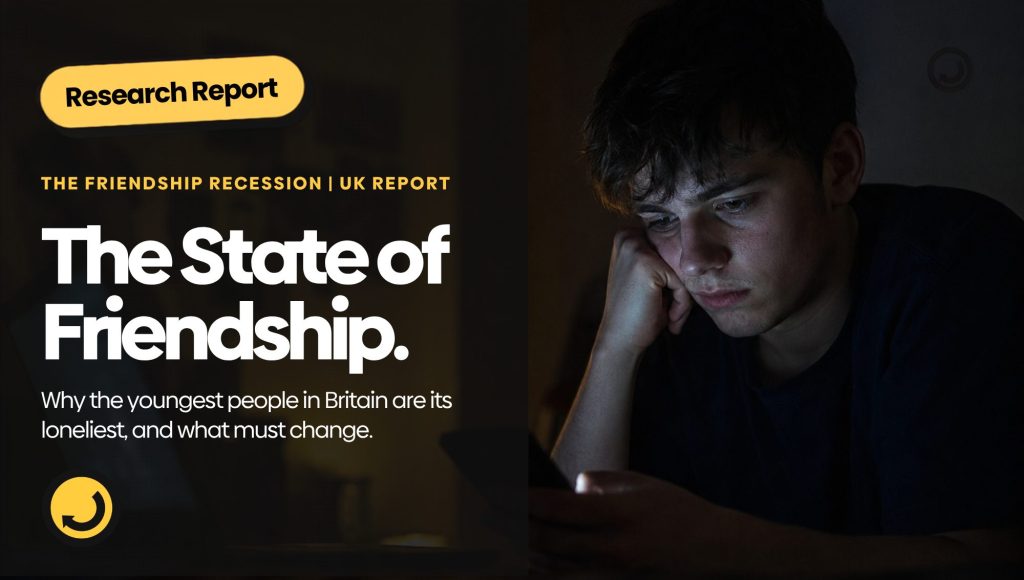
To mark International Friendship Day, we’ve published The State of Friendship – a new report bringing together the leading evidence on youth loneliness, friendship and social connection.
The evidence points to a clear conclusion: friendship is in recession. Young people are spending less time with friends, struggling to form close relationships and losing access to the places where connection once happened naturally.
The report examines what is driving this decline, the consequences for young people and what must change.

Friendship is retreating from daily life
One of the report’s most striking findings is just how dramatically our social lives have changed over the past 20 years.
The most detailed long-term evidence comes from the United States, where daily time spent with friends fell by 57% between 2003 and 2023, from 60 minutes to just 26. The decline affected every age group, but was steepest among younger people.
The hours once spent together have increasingly been replaced by solitary entertainment, remote communication and time at home.
That shift matters because friendship rarely develops through a single introduction. It grows through proximity, repetition and shared activity – seeing the same people regularly, doing something together and gradually becoming part of one another’s lives.
However, those opportunities are becoming harder to find.
Around 68% of 18 to 30-year-olds in the UK have reduced their participation in nightlife because of the economic climate, while 61% go out less than they did a year ago.
At the same time, youth clubs, pubs, nightclubs and affordable community venues are closing or becoming less accessible.
Meanwhile, 87% of 18 to 30-year-olds believe their generation has fewer opportunities to connect in person, build confidence and be creative than previous generations.
Young people have not lost the desire for friendship. They are losing the time, places and financial freedom needed to build it.
The loneliest generation
We have seen a similar shift in loneliness. For decades, loneliness was framed primarily as a problem of older age. But when national data began revealing who was most affected, it overturned that assumption.
The loneliest people in Britain were not the oldest, but the youngest.
Young adults are now more than twice as likely to experience chronic loneliness as the oldest age group, with 9.7% of 16 to 29-year-olds reporting that they feel lonely often or always, compared with 3.7% of people over 70.
The change becomes even more striking when Britain is compared with the rest of Europe. Analysis of the latest European Social Survey found that 10.2% of British adults under 30 felt lonely most or all of the time – the highest rate in Europe.
In 2013, young British adults were no lonelier than the European average. A decade later, they had become the loneliest on the continent.
The consequences extend far beyond the feeling itself. Some 72% of 16 to 25-year-olds say loneliness harms their mental health and wellbeing, while 30% associate it with poorer sleep and diet.

Work is no longer a friendship factory
For generations, the workplace was one of the main places where adult friendships formed.
People encountered the same colleagues every day, worked through shared challenges and spent informal time together before work, over lunch and after hours.
Friendship emerged as a natural by-product of working life. That machinery is now being weakened by hybrid working, fragmented schedules and insecure employment.
Today, 38% of UK workers aged 16 to 24 feel lonely or socially isolated because of their working circumstances, compared with 24% of employees overall.
Older workers often entered remote and hybrid work with established personal and professional networks. Younger workers are trying to build those relationships for the first time through scheduled calls and digital messages, without the informal encounters through which trust and friendship once developed.
For those outside employment or education, even that source of routine, contact and belonging is absent. More than one million young people – 13.5% of all 16 to 24-year-olds – are not in education, employment or training.
What is less often discussed is the damaging cycle this can create.
Unemployment can deepen isolation by removing daily structure, reducing social contact and limiting opportunities to build friendships and support networks.
Loneliness then chips away at the confidence and motivation needed to move forward. Some 62% of lonely young people say it makes them lose confidence in themselves, while 48% say it makes them less likely to want to progress at work.
With lower confidence, weaker support networks and fewer opportunities to practise everyday social interaction, returning to education or employment becomes even harder. Young people can become trapped in a cycle in which unemployment deepens isolation, while isolation makes unemployment more difficult to escape.
When technology substitutes for friendship
Technology can sustain genuine relationships, particularly for people who face barriers to meeting others in person.
However, recent research found that 48% of UK 18 to 29-year-olds say social media makes them feel lonelier, compared with 30% who feel it helps them connect.
At the same time, more effortful forms of communication appear to be weakening. Many young people now find small talk intimidating and phone calls stressful, while algorithmic feeds are replacing the shared entertainment that once gave friends common experiences to discuss.
Gaming shows both sides of the picture. As physical third spaces close, much of young social life has migrated into games.
US research has found that 72% of teenage gamers regularly play multiplayer games, often with friends they know online or offline, while around four in ten Britons name gaming as a preferred way to socialise.
For many young people, gaming communities provide genuine friendship, belonging and support. The critical question is whether technology strengthens human relationships or begins to replace them.
The arrival of AI has made that question even more urgent.
Almost half of 16 to 24-year-olds have used AI instead of speaking to a person about their mental health, including 31% who used it instead of talking to a friend.
AI is always available, attentive and designed to respond without judgement. Real friendship is slower and less predictable because it requires mutual effort, vulnerability and compromise. Yet those qualities are also what allow us to feel genuinely known, valued and supported.
Technology should help people connect with one another, not offer a frictionless substitute for human relationships.

What needs to change
Without action, many of the forces driving the friendship recession are likely to intensify. AI companionship will become more sophisticated, financial pressures will continue to restrict social life and workplaces may become even more fragmented.
A structural problem requires a coordinated response from the institutions shaping young people’s everyday lives.
The State of Friendship calls for coordinated national action:
– Government and the NHS must recognise social health as a core part of overall health, embedding loneliness prevention across healthcare and treating young adults as a priority group.
– Local authorities and planners must design social connection into communities, protecting affordable venues and creating housing, transport and public spaces that allow people to meet repeatedly.
– Government and employers must tackle workplace loneliness, with stronger onboarding, dependable opportunities for in-person contact and social connection treated as central to staff wellbeing, retention and productivity.
– Regulators and technology companies must protect young people’s social health, introducing safeguards for AI companions and ensuring technology strengthens human relationships rather than replacing them.
– Government, funders and the media must help destigmatise loneliness, supporting education and national campaigns so the age group at greatest risk is no longer the least likely to seek help.
These recommendations build on our cross-government call to action on loneliness and connection. Launched alongside partners working across the loneliness sector, the call culminated in an invitation to 10 Downing Street last month.
With new leadership now in place, we are calling for this momentum to be translated into coordinated action across government.
Loneliness cannot be solved by asking individuals to try harder. Young people need affordable places to meet, workplaces that foster belonging, communities designed around connection and technology that strengthens human relationships rather than replacing them.
No single organisation or intervention can deliver that alone – reversing the friendship recession will require government, employers, local authorities, funders, healthcare providers and technology companies to work together to rebuild the conditions in which friendships can form and endure.
The urgency to act is clear. Without intervention, the forces driving young people apart risk becoming further embedded in how we live, work and connect, carrying the consequences of today’s friendship recession into the decades ahead.
This new State of Friendship report brings together the leading research on youth loneliness, friendship and social connection to provide a far-reaching picture of the friendship recession in Britain.
It serves as both a warning and a blueprint. It brings the evidence together not simply to document what young people are losing, but to show how government, employers, communities and technology companies can begin rebuilding the conditions for connection.
If you would like to explore the evidence, findings and recommendations in full, you can read here.