

Something has changed in the way we talk about men.
Male loneliness – once rarely discussed outside mental health circles – now seems to be everywhere.
It appears in newspaper features about the “crisis of boys and men”, podcasts exploring the decline of male friendship and wider debates about the manosphere, poor mental health and why some young men feel increasingly disconnected from society.
So why has male loneliness become such a significant cultural concern? Are men really experiencing a distinct loneliness epidemic – or is something more complicated happening beneath the headline?
Are men really experiencing a loneliness epidemic?
There are good reasons for the growing concern.
In June, the UK Government published a major study devoted specifically to loneliness, isolation and social connection among boys and young men. It found that 13% of men aged 16 to 25 felt lonely often, while a further 36% felt lonely some of the time.
Yet the picture is not as straightforward as the headlines sometimes suggest. When researchers compare men and women, men do not consistently report greater loneliness. In some studies, young women are slightly more likely to say they feel lonely.
The more important question, then, is not simply how many men feel lonely. It is how that loneliness develops, how men respond to it and what opportunities they have to escape it.
Loneliness can be painful for anyone. But for some men, that pain is compounded by the feeling that they should not be experiencing it in the first place.
Admitting to loneliness can feel exposing. It may be interpreted not simply as “I need more connection”, but as “people do not want me around” or “I have failed socially”.
That shame can make the problem harder to escape. Loneliness can slowly erode somebody’s confidence, making social situations feel more intimidating and rejection more personal.
A man may turn down an invitation because he feels awkward, avoid messaging an old friend because too much time has passed or decide against joining a group because he assumes everybody else will already know one another.
Each decision makes sense in the moment. Together, they can create a cycle in which loneliness leads to withdrawal, withdrawal reduces opportunities for connection and the resulting isolation appears to confirm the belief that something is wrong with him.
Male loneliness and gender stereotypes
Some of the challenges surrounding male loneliness are rooted in longstanding gender stereotypes.
From an early age, many boys absorb the idea that a man should be tough, independent and capable of dealing with his problems alone. Emotional vulnerability can be treated as weakness. Loneliness can feel like failure, while asking for support can seem like an admission that somebody is failing to cope.
These expectations also affect how men show up in their friendships. Even men who care deeply about their friends may find it difficult to express that care or struggle to move beyond surface-level conversation.
Men may become comfortable discussing work, football, dating or weekend plans while rarely talking about anxiety, grief, insecurity or disappointment.
A man may know his friend’s football team, usual drink and favourite game without knowing what has been keeping him awake at night.
And so undeniably, there needs to be a shift in how we think about masculinity and a transformation in how men show up for one another.
Men do need to become more comfortable with vulnerability and more willing to “open up”. Honest conversations can deepen relationships, while silence can prevent friends from recognising when somebody is struggling.

Why telling men to “open up” is not enough
But opening up requires more than individual courage. Opening up requires somebody trustworthy on the other side of the conversation, a relationship capable of holding what is shared and enough continued contact for that honesty to lead somewhere.
A man who sees his closest friend twice a year may find it difficult to move suddenly from football and work to depression, grief or relationship problems. If his friendships have never included emotional conversations, being told to initiate one can feel unnatural and exposing.
The instruction to “open up” can also make loneliness sound like an individual failure. If a man feels isolated, the implication is that he has not communicated clearly enough, shown enough vulnerability or made enough effort.
But honest conversations require trust, familiarity and relationships in which vulnerability feels safe and those conditions take time to develop.
Where such relationships do not yet exist, men need spaces in which new connections can form, reasons to see one another regularly and enough repeated contact for trust to grow.
It is much easier to share something difficult with somebody who is already part of your everyday life than with a friend you have not seen for six months.
Addressing male loneliness therefore requires both a change in how men relate to one another and a rebuilding of the social conditions in which meaningful friendships can develop and survive.
Friendship requires regular contact
The number of friends somebody has does not tell us everything about the quality of their relationships. But regular contact remains closely associated with how connected and supported people feel.
Chronic loneliness affected 9% of young men who met friends in person daily or several times a week. Among those who saw friends less than once a week, the figure rose to 21%.
Similarly, only 4% of young men who met friends almost every day felt isolated often, compared with 21% of those who saw friends less than weekly.
These figures do not prove that infrequent contact directly causes loneliness. They do, however, point to a clear relationship between face-to-face contact and how socially connected young men feel.
How male friendships quietly disappear
At school or university, much of that contact happens automatically. The same people are in the same places at roughly the same time, allowing friendships to develop without much deliberate organisation.
Adult life removes that structure.
Every meeting has to be arranged. Diaries have to align. Travel, money and competing responsibilities all become factors. A cancelled evening can take another month to reorganise.
Careers become more demanding. Relationships grow more serious. People move to different parts of the country. Children arrive. Someone gets injured and stops attending the weekly football game. Another begins working remotely and loses the everyday contact once provided by the office.
Social media and group chats can help people remain loosely connected, but they do not automatically preserve closeness. Sometimes, somebody we continue to describe as a close friend has gradually become a person we used to be close to.
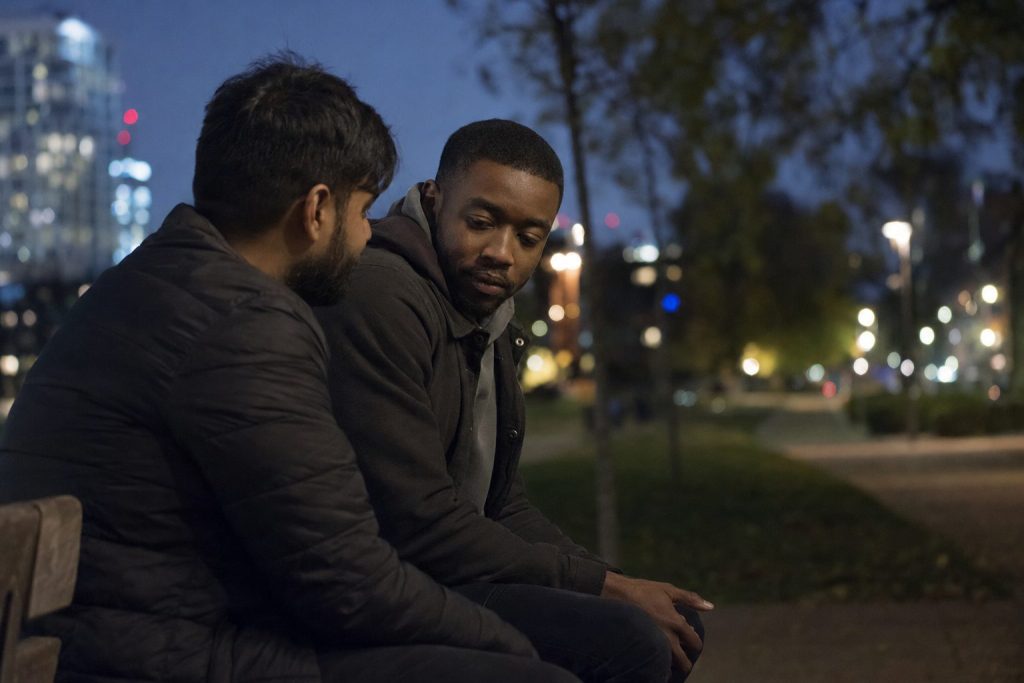
After all, male friendships rarely end because of a dramatic argument. More often, they quietly fade.
Nobody consciously decides to stop being friends. There are simply fewer plans, fewer messages and longer gaps between conversations. Weeks become months, then months become years.
By the time somebody needs emotional support, the care may still exist – but the regular contact that once made honesty feel natural has disappeared.
Participation can rebuild the missing structure
If repeated contact helps friendships grow, then participation matters. Walking groups, sports clubs, volunteering, board-game nights, classes and community activities can all help because they provide a clear time, place and ongoing reason for people to meet.
The government study found that young men aged 17 to 25 who participated in clubs, groups or community organisations experienced lower levels of loneliness than those who did not.
Among young men taking part in no weekly organised activities, the predicted probability of loneliness was 56%. Among those who participated at least sometimes, it was 25%.
Joining a group is not a guaranteed cure for loneliness. People can attend activities and still feel disconnected, while those experiencing poor mental health may find taking that first step particularly difficult.
But regular activities create some of the conditions in which connection is more likely to grow. They remove the pressure of having to approach a stranger without context, provide something to do alongside the conversation and make it possible to encounter the same people repeatedly.
Familiarity matters. Before somebody becomes a close friend, they usually have to become a familiar face.
Research suggests that forming a close friendship can take around 200 hours together. Those hours cannot be accumulated if people have nowhere to meet, no reason to return and no structure that keeps bringing them into one another’s lives.
Male loneliness is not an individual failure
Men can and should take steps to strengthen their relationships. They can contact the friend they have not seen in months, accept invitations when withdrawal feels easier and treat friendship as something worth making time for.
They can ask more meaningful questions, express care more openly and become better at recognising when a friend may be struggling.
But they cannot solve this problem alone.
Employers can create genuine opportunities for regular social interaction rather than treating connection as an occasional team-building exercise. Councils and funders can invest in affordable community spaces, local organisations and activities that give people a reason to meet repeatedly.
Sports clubs, community centres, libraries, pubs and shared-interest groups all form part of the social infrastructure through which relationships begin and survive. When those spaces disappear, people do not simply lose somewhere to spend an evening. They lose opportunities to belong.
Health services can recognise social disconnection earlier and connect people with appropriate local opportunities alongside any clinical support they may need.
Governments must also treat social connection as a serious public-policy priority. That means investing in the places and organisations that bring people together, designing neighbourhoods that make interaction easier and considering how decisions about housing, transport, work and public services affect people’s ability to build and maintain relationships.
Above all, we need to stop treating friendship as a luxury and start recognising it as an essential part of our health and happiness.
On an individual level, men should be encouraged to invest in their friendships just as deliberately as they invest in their careers, finances, romantic relationships and physical health.
But society must make that investment possible by protecting the time, places and communities through which friendship is built.
Male loneliness may not be a straightforward epidemic in the statistical sense. But the weakening of close friendship among some men is real, its consequences are serious and it deserves more than another instruction to “open up”.
If we want men to feel less alone, we need to make meaningful connection easier to build and far harder to lose.
