
Last week, the UK announced a landmark ban on social media for under-16s, joining a growing number of countries attempting to tackle concerns about the impact these platforms are having on young people’s wellbeing.
The move has been welcomed by many parents, with recent polling suggesting that as many as nine in ten support stronger restrictions on children’s access to social media.
If you ask most parents why they support it, the answer is unlikely to be that they believe social media is inherently bad. Many use it themselves and recognise the benefits it can bring.
Parents can see the hours spent scrolling. They see the impact on confidence and attention, the pressures of comparison, the disruption to sleep, and the way online life can sometimes crowd out real-world experiences. Yet many feel they have very few practical tools available to address these challenges.
In many ways, the popularity of the ban says as much about a lack of alternatives as it does about the proposal itself. The support may reflect a growing sense of powerlessness.
It also reflects an acceptance of wider failure by governments around the world to have properly understood, regulated and respond to the social and psychological harms that have emerged in an increasingly digital world.
For years, social media companies have been allowed to grow at extraordinary speed whilst policymakers have struggled to keep pace with the consequences.
So whilst it’s encouraging to see governments finally taking action, there is a danger that a blanket ban becomes a blunt solution to a far more complex problem, and the truth is that it is unlikely to be a silver bullet.
There will inevitably be ways around the rules. Some young people may simply migrate to less regulated platforms. Others may feel excluded from social spaces where their peers continue to interact.
Critics have also raised concerns that restrictions could inadvertently increase feelings of isolation for some young people if they are not accompanied by meaningful alternatives for connection and belonging.
But perhaps the biggest limitation of the current debate is that it risks missing a much larger point.
Social media is not just a problem for children.
The impacts of social media do not suddenly disappear on someone’s sixteenth birthday. They continue to shape the lives of university students, young professionals, parents and older adults too.
In fact, young adulthood is one of the most important periods for developing identity, forming habits, building confidence and establishing the relationships that often shape the rest of our lives.
So whilst children may be most vulnerable to the immediate harms of social media, young adults may provide an early indication of what the long-term consequences can look like.
This generation was among the first to grow up with smartphones, social media feeds, likes, followers and algorithm-driven content as a constant presence throughout both adolescence and early adulthood.
As a result, today some of the groups reporting the highest levels of loneliness are not school children, but young adults.
And so if the government’s goal is to really help address this for current and future generations – it is not enough to delay the problem until the age of sixteen. Nor should we accept that those already over sixteen are somehow beyond help.
Instead, we need to understand how social media may be shaping loneliness across the entire life course – and what we can do about it.
How Social Media Fuels Loneliness
With that in mind, researchers have identified a number of ways in which social media can contribute to feelings of loneliness and social disconnection:
1. Social Comparison
Human beings have always compared themselves to others, but social media has amplified that tendency dramatically.
Every day we are exposed to a carefully curated stream of holidays, birthdays, promotions, relationships, friendship groups and achievements. We see people’s best moments presented one after another, often without any of the context that sits behind them.
What we don’t see are the lonely evenings, the cancelled plans, the awkward social interactions, the relationship difficulties, the self-doubt or the countless ordinary days that make up most people’s lives.
Over time, this can create a distorted perception of reality in which everyone else appears happier, more successful and more socially connected than we are.
When people already feel lonely, this comparison can become particularly damaging because it reinforces the belief that everyone else belongs whilst they do not.
It provides daily reminders of the plans they weren’t invited to, the friendships they don’t have, and the communities they don’t feel part of.
2. Substitution
One of the simplest explanations is also one of the most important. The problem is not simply that social media consumes time. The problem is that it can gradually displace the very activities through which friendships are built, maintained and strengthened.
Of course, not every hour spent on social media would otherwise be spent with friends. But social media often occupies precisely those moments where real-world connection once had the opportunity to emerge.
An evening that might once have involved calling a friend becomes an evening scrolling through their updates. A catch-up over coffee becomes a WhatsApp message. A conversation becomes a reaction. In many cases, the appearance of connection begins to replace the experience of it.
The convenience is undeniably appealing when we have busy lives. But convenience comes with a trade-off. Social media often provides a lower-effort substitute for the conversations, shared experiences and repeated face-to-face interactions that create genuine connection, belonging and lasting friendships.
3. The Illusion Of Connection
Social media gives us unprecedented access to information about other people’s lives.
We know where people have been on holiday. We know who they are spending time with. We know what they had for dinner, where they work and what they think about the latest news story. This creates a feeling of familiarity that can easily be mistaken for connection.
The reality, however, is that knowing about someone’s life is not the same as having a meaningful relationship with them. We can follow hundreds of people online whilst having very few people we would actually call when we need support.
In many cases, social media provides the appearance of connection without delivering the depth of connection that protects against loneliness.
4. Validation Becomes Measurable
For most of human history, social approval was difficult to quantify. Today it arrives in the form of likes, comments, shares, followers and views.
Social media has transformed social feedback/approval into something that can be measured, tracked and compared. For some people, this subtly changes the way they evaluate themselves. Instead of focusing on the quality of their relationships, they begin paying attention to signals of popularity and approval.
The problem is that attention is not the same as connection. Someone can receive hundreds of likes on a post and still feel profoundly lonely. External validation can create a temporary boost in mood, but it rarely provides the deeper sense of belonging that comes from genuine relationships.
5. We Become Passive Observers
Perhaps one of the most overlooked consequences of social media is the way it can move people from participation into observation.
Rather than spending time creating experiences, we increasingly spend time watching other people have them. Rather than joining conversations, we consume them. Rather than building relationships, we observe other people’s relationships unfold.
Over time, this can create the feeling that life is happening somewhere else and that we are simply spectators.
That experience of constantly watching from the sidelines can be particularly harmful for people experiencing loneliness because it reinforces a sense of exclusion.
This is reflected in much of the research on social media use. Studies consistently find that passive use – scrolling, browsing and consuming content – is more strongly associated with loneliness and poorer wellbeing.
The more time people spend observing other people’s lives without interacting, contributing or building relationships themselves, the more likely they are to experience the feeling of standing on the outside looking in.
By contrast, active use – messaging friends, organising plans, participating in communities and engaging in conversations – tends to show far weaker negative effects and can sometimes even be beneficial.
One of the most influential studies in this area came from researchers at the University of Pennsylvania in 2018. Participants were randomly assigned to either continue their normal social media use or limit it to just 30 minutes per day across all platforms.
After only three weeks, those who reduced their usage reported significantly lower levels of loneliness and depression.
In short, social media appears to be at its most harmful when it becomes a substitute for participation, and at its most helpful when it facilitates genuine connection.
So What Can We Do About It?
Critically, therefore, the challenge isn’t simply using social media less. As individuals, there’s also a responsibility for us to use it differently:
- Move from consuming to connecting. Try to use social media to strengthen relationships rather than replace them. Message people directly, reply to stories, check in with friends and make plans.
- Reframe what you’re seeing online. When comparison creeps in, remember that you are seeing highlights, not full lives. The moments people share publicly are rarely representative of the entirety of their experience.
- Creating space for real-world connection. Friendships are built through shared experiences. Whether that’s joining a club, volunteering, attending community activities or simply saying yes to more invitations, meaningful relationships still require time spent together.
- Add friction to endless scrolling. App limits, notification controls and screen-free time can help ensure that social media remains a tool rather than becoming the default way you spend every spare moment.
The Bottom Line
On a policy level, we believe the debate shouldn’t stop at whether children should have access to social media or how to keep young people safe online.
A bigger conversation now needs to take place about how technology is shaping the way we connect, communicate, build relationships and experience belonging.
Because whilst social media and AI can help us organise plans, access information and stay in touch, they cannot replace the conversations, shared experiences, trust and time that meaningful friendships require. They cannot replace the feeling of being part of a community, having people you can rely on, or knowing that there are others who genuinely care whether you show up or not.
Without a much wider conversation about how technology is shaping our relationships, attention and behaviour, a ban like this is unlikely to solve the deeper problem.
It is also time we learned the lessons of social media and applied them to the next generation of technology – rather than waiting years to understand the consequences before taking action.
Instead, we should be asking difficult questions now.
- How do we tackle the rise of harmful online communities and algorithm-driven content that can amplify isolation, division and extremism?
- How do we ensure that technology companies are designing products that support wellbeing and connection, rather than simply maximising engagement?
- How do we ensure that AI and digital communication remain tools that facilitate human connection, rather than gradually replacing it?
- And above all, how do we create more opportunities for real-world connection, so that young people don’t have to look to technology in the first place?
Because if loneliness is one of the defining social challenges of our generation, then preventing harm alone will never be enough.
We must also create the conditions that allow friendship, community and belonging to flourish.
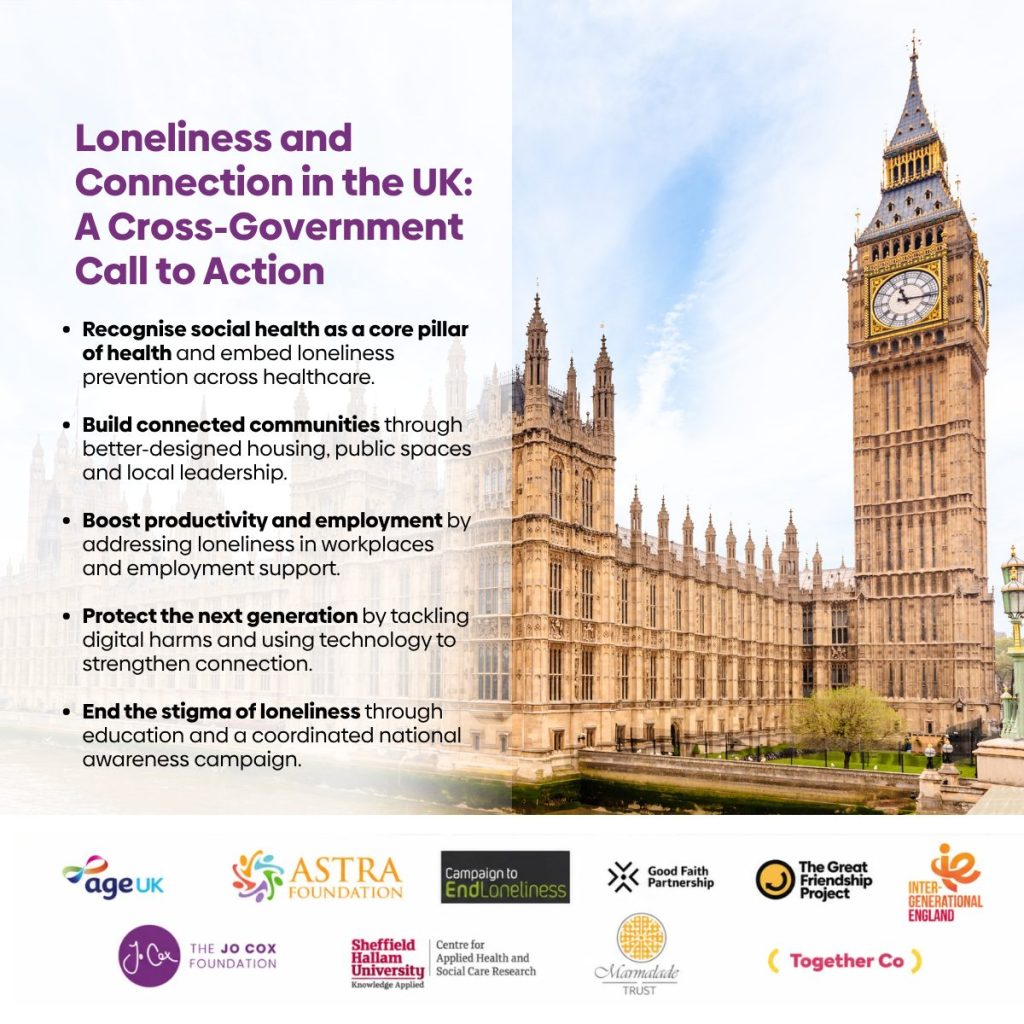
That’s why this month, alongside nine other leading organisations tackling loneliness and social disconnection, we called on the Government to take a broader approach to tackling loneliness and digital harms through a new Call to Action.
Our recommendations included working more closely with technology companies, investing in opportunities for real-world connection, strengthening community infrastructure, and recognising social health, alongside physical health and mental health.
If you’d like to learn more about the changes we’re calling for, you can read the full cross-government call to action below.
