

Loneliness is often talked about as an emotional experience. But growing evidence suggests it affects far more than mood – influencing sleep, stress, energy and long-term health in ways we are only beginning to fully understand.
Loneliness is often spoken about as a feeling – something uncomfortable, but temporary. A difficult period. A phase people are expected to eventually “snap out of.”
But loneliness is increasingly understood as more than an emotional experience. Research suggests it can shape how people sleep, how much energy they have, how they cope with stress, and even long-term physical health.
This is not simply observation or intuition. It is something evidence has been steadily reinforcing over time.
Large-scale studies, including a major meta-analysis by Holt-Lunstad and colleagues (2010), found that people with stronger social relationships had significantly better survival outcomes over time, while social isolation and loneliness were associated with increased risk of early death.
More recently, a 2023 meta-analysis published in JAMA reinforced this relationship across millions of people, adding to growing evidence that social connection plays a meaningful role in health and wellbeing.
Importantly, loneliness is not the same thing as being alone.
You can be surrounded by people and still feel disconnected. Equally, someone can spend time alone without feeling lonely at all. What often matters most is whether there is a steady sense of meaningful connection in everyday life – relationships, routines and places that help people feel seen, familiar and part of something.
Loneliness and health – what we’re learning
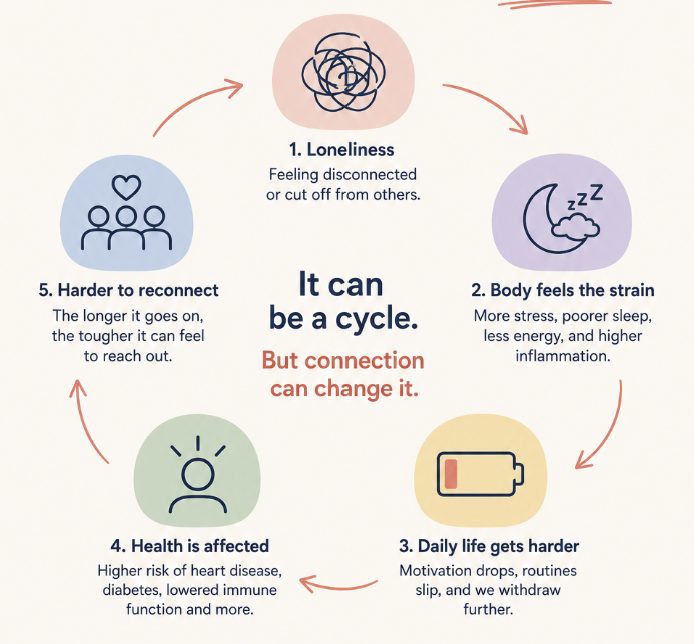
Over the last decade, researchers have increasingly linked long-term loneliness with a range of health challenges, including poorer cardiovascular health, disrupted sleep, weaker immune function and higher levels of chronic stress.
But the effects of loneliness are not always dramatic or immediately visible. More often, they show up quietly in everyday life.
It might look like:
- sleep becoming lighter or more disrupted
- feeling more tired or depleted than usual
- less motivation to move, socialise or stay active
- routines gradually slipping without much notice
These experiences are easy to dismiss as laziness, low motivation or simply “having a bad week.” But often they reflect something deeper: the effect of ongoing stress combined with too little positive social connection.
When people feel disconnected for long periods of time, the body can remain in a low-level state of stress – not intense or obvious, but persistent. A kind of background tension that never quite switches off.
Research suggests that over time this stress response may influence sleep regulation, inflammation, immune function and overall wellbeing.
It can also shape behaviour in quieter ways.
People may begin to withdraw socially, move less, stop attending activities they once enjoyed, or lose confidence in situations that previously felt manageable. Not because of a lack of willpower, but because everyday life begins to feel heavier.
The difficult part is that loneliness can become cyclical.
The more disconnected someone feels, the harder it can become to step back into social situations – particularly when those spaces feel unfamiliar, pressured or overwhelming.
Why community matters
One of the clearest shifts in how we understand loneliness is recognising that it is not only an individual experience – it is also shaped by environment.
In other words, connection becomes easier or harder depending on whether there are places, routines and communities that support it.
That means the answer is not simply telling people to “try harder” to socialise or push themselves into uncomfortable situations. It is also about creating spaces where connection feels easier, more natural and more accessible.
For many people, belonging does not begin with deep conversations or large social groups.
It begins with smaller things:
- seeing familiar faces regularly
- recognising people over time
- having somewhere to go where you are not starting from zero each time
- being around others without pressure or expectation
This is where community organisations like The Great Friendship Project can play an important role.
Not through dramatic interventions or quick fixes, but through consistency – creating regular, low-pressure spaces where people can show up as they are, reconnect at their own pace, and slowly rebuild confidence and familiarity.
For people who have felt disconnected for a long time, that consistency can matter more than we often realise.
A cycle that can be reversed
Loneliness can narrow life in subtle ways. It can affect confidence, motivation, energy and even the willingness to leave the house.
But the reverse can also be true.
Research increasingly suggests that repeated moments of social connection – even small ones – can positively shape wellbeing over time.
A familiar face. A conversation that feels easier than expected. A reason to leave the house on a Tuesday evening.
On their own, these moments may seem ordinary.
But repeated consistently, they can begin to interrupt the cycle of loneliness and gradually rebuild a sense of confidence, belonging and connection.
That is ultimately what community makes possible.
Not the promise of “fixing” loneliness overnight, but creating the conditions where connection becomes easier to access, often enough, that it begins to rebuild itself naturally.
Closing thought
Loneliness is not simply about being alone.
It is about feeling disconnected over time – and the effects can reach far beyond emotion.
It can shape sleep, energy, motivation, confidence and health in ways that are easy to overlook.
Which is why community matters so much.
Not as an abstract idea or grand solution, but as something practical and lived: familiar faces, shared routines, somewhere to belong, and regular moments of connection that quietly remind people they are not quite as alone as they may have felt.
That is the space we are trying to hold – not dramatic solutions, but steady connection.
