Last week marked the biggest annual celebration of friendship in the world. And yet you probably wouldn’t have known.
Yep, every year, International Friendship Day is recognised by the United Nations, but despite its official status, it passes with remarkably little attention.
There were no cards lining supermarket shelves, no flowers being delivered and little of the fanfare reserved for the other important relationships in our lives. For most people, the day came and went without them even realising it existed.
It could just be bad marketing but I think it’s also very telling.
Every year, we celebrate romantic partners and family through widely recognised traditions. Yet friendship – despite being a huge part of our lives – receives almost none of the same recognition. There are no established rituals for celebrating it, protecting it or repairing it when it begins to fade.
Instead, friendship is treated as the relationship that should somehow look after itself. It is expected to survive cancelled plans, unanswered messages, new jobs, house moves, romantic relationships and months of saying, “We really must catch up soon.” And then we are surprised when it doesn’t.

We say friendship matters, but do we treat it that way?
Most of us would describe our friends as some of the most important people in our lives. But friendship is often the first thing pushed to the edge of the calendar: the arrangement that can be postponed, the relationship asked to understand and the part of life we promise to return to once everything else settles down.
The problem is that adulthood rarely settles down. There is always another deadline, expense or responsibility. Friendship does not survive on affection alone; caring about someone is not the same as continuing to share a life with them.
Friendship requires time, repetition and shared experiences. Research suggests it can take more than 200 hours together to form a close friendship.
Yet we increasingly organise adult life as though meaningful relationships should emerge from a single introduction, an app or one awkward networking event.
We want the security of friendship without always protecting the conditions that allow it to grow.
Britain is experiencing a friendship recession
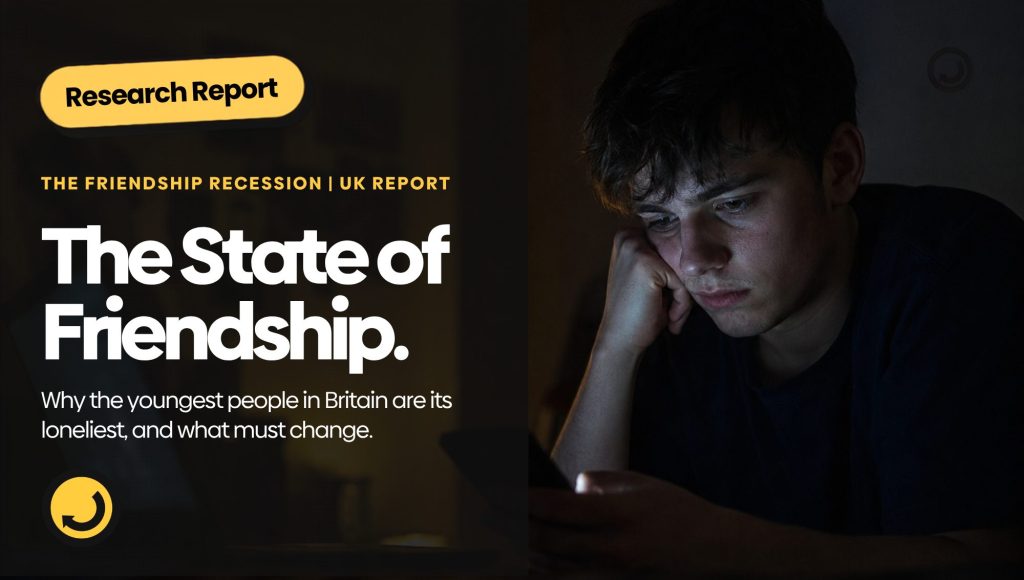
Our new State of Friendship report brings together leading research on youth loneliness, friendship and social connection. Its findings suggest that this is not simply a problem of a few individuals failing to “put themselves out there”. Britain is experiencing something much bigger: a friendship recession.
Young people are now among the loneliest in society. Around 9.7% of 16–29-year-olds experience chronic loneliness, compared with 3.7% of people aged over 70. One in ten people in Britain reports having no close friends at all.
At the same time, daily time spent with friends in the United States fell by 57% between 2003 and 2023. Those hours have not vanished; many have been reallocated to scrolling, streaming and spending time alone.
We now have more ways to contact one another than any previous generation, but contact is not the same as closeness. A busy group chat is not necessarily a support network. Watching somebody’s life unfold online is not the same as being part of it. We can know what hundreds of people are doing without having anyone who truly knows how we are.

This is not just a personal failure
We often respond to loneliness with individual advice: message someone, join a club or make more effort. Those things can help, but they ignore the environment in which friendship now has to survive.
Young adults are being priced out of social life, with 68% of 18–30-year-olds cutting back on going out. Affordable places to meet repeatedly are disappearing, while 37% of young people say they have no opportunities to meet new people and make friends.
Work has also become less reliable as a “friendship factory”. Remote and hybrid working have brought important freedoms, but casual conversations and repeated contact have reduced for many.
Some 38% of workers aged 16-24 feel lonely or isolated because of their working circumstances, compared with 24% of workers overall.
Then there are the repeated social ruptures of young adulthood: leaving education, starting work, moving city, changing jobs, losing a relationship or moving into unfamiliar accommodation. Each transition can dismantle a social network and force someone to begin again.
This is why loneliness cannot be treated simply as a confidence problem. It is also a design problem. We have made it harder and more expensive to spend time together, removed many of the spaces where friendship used to form and then blamed individuals for struggling to connect.
Friendship is not an optional extra
Social connection is often treated as something pleasant to enjoy once the serious parts of life – work, housing, education and health – have been addressed. But friendship is not decoration around the edges of a good life; it is part of its foundation.
Strong social relationships are associated with better physical and mental health, while loneliness affects healthcare, productivity, community trust and social cohesion. If we recognise roads, homes and hospitals as essential infrastructure, we should also recognise social connection as preventative infrastructure.
That means affordable community activities, welcoming public spaces and housing designed to encourage interaction. It means workplaces taking belonging seriously and technology companies helping people strengthen human relationships rather than replace them.
An introduction alone will not fix loneliness. Friendship develops through proximity, repetition and shared activity: seeing the same people regularly, doing things together and allowing trust to accumulate over time.
We have watched that happen repeatedly through The Great Friendship Project.
People arrive at their first event visibly nervous, then gradually begin to relax, return and recognise familiar faces.
We have seen empty weekends become full again, new friendships become support networks and people grow into versions of themselves they might barely have recognised before.
Those transformations rarely come from one spectacular moment. They happen because somebody comes back, and somebody else comes back too.

Treat friendship like it matters
The fact that International Friendship Day passed with so little attention should make us question how seriously we value friendship throughout the rest of the year.
Why is repeatedly postponing time with a friend considered understandable when doing the same to a romantic partner might provoke a serious conversation?
Why do we tell lonely young people to put themselves out there when so many have been priced out or designed out of the places where friendship used to happen?
And if social connection protects our health, why do we continue funding it as an optional extra?
This week, schedule the catch-up you have mentioned for months. Check in with the friend who has become quieter. Restart the group chat that has gone silent, or tell somebody what their friendship has meant to you.
But do something more difficult too: keep showing up once this week has passed.
Friendship does not need one grand gesture each year. It needs protected time, repeated effort and a culture that recognises it as one of the relationships on which a healthy life depends.
And if you have not found your people yet, you are not the only one. Loneliness at 22 is not a life sentence. It is partly a design flaw in how we have built young adult life and design flaws can be fixed.
Read “The State of Friendship” Report
Our new State of Friendship report brings together the leading research on youth loneliness, friendship and social connection to provide a far-reaching picture of the friendship recession in Britain.
It serves as both a warning and a blueprint. It brings the evidence together not simply to document what young people are losing, but to show how government, employers, communities and technology companies can begin rebuilding the conditions for connection.
Read “The State of Friendship” Report in full